Completed NEA

 Dear Moderator, 

My name is Phoebe Birney. Welcome to my A Level Media Studies blog. This is a record of the work I have undertaken for the Making Media Non-examination Assessment (NEA) within the OCR H409 GCE A Level course in Media Studies. 

I worked independently on Brief 3: Magazine and Online to produce the front covers and contents pages for the first two editions of a film magazine called The Fourth Wall together with the magazine's accompanying website.

Research and Planning

Further down in my blog you will find evidence of my research and planning for this task.

Magazine Covers and Contents Pages

Magazine first edition cover and contents page


Magazine second edition and contents page


Magazine Website

The link to my website, which was created using Wix, can be found at the link below. 

The Fourth Wall

The magazine consists of a homepage and a single linked page. This page can be accessed by clicking on features. 

NEA Task 21 (Planning) : Photography Planning


 1. Who will you be using as your models for each photograph

For my 4 original images for my covers, contents and website pages I will be using a male and female model, alongside other original images I will shoot. For my 1st cover I will be using my friend maisy and for the 2nd it will be my friend Harri, this will then create a clear representation of two social groups male and female. For my contents pages and website images I will use a range of images with no models as well as some with other male and female friends. I will pretend these models are actors, actresses and directors that feature in the films I will mention in my magazine and website.

2. What thought needs to be given to the following

elements of mise-en-scene?


Location: When deciding on the location of my images I have decided the 1st edition image should have a very simplistic location; the feel of a classic photoshoot so the attention of the audience can be solely on Maisy. I think a white or neutral backdrop will fit the aesthetic I am aiming for. As for my 2nd edition there will be a complete juxtaposition in the image setting, as it is promoting the Hunger Games film it will be set in a woodland/forest area to showcase an ‘arena’ like image, similarly to the arena in the previous movies. As for the location of the contents images they will be similar to the ones used in each edition as they will relate to their retrospective cover. The website however will feature images that range from outside images, maybe of the sunset to use as a scene from a film or of other models (my friends) in a photoshoot setting.


Costume: For the 1st edition that will feature my female model Maisy, as I aim for the focus to be solely on her, she will wear simple clothing like a neutral coloured t-shirt and jeans. As for her makeup, it will be very natural therefore there is full attention on her and will showcase the aesthetic of my magazine; simplicity and the raw beauty of cinema. For the second edition my male model Harri will wear simple clothing but it will be ruined, have holes and covered in dirt to signify the battle that occurs in the Hunger Games films. 


Props: As for props there will not be many featured in my images, there will be a stool used in my first edition with my model Maisy as in the image she will be sitting on it in a crouched pose. As for my second image, I may use something that will resemble a weapon to showcase the Hunger Games.


Body Language of my models: As for my first edition with my model maisy, she will have relaxed body language as she will be slouched over her knees to convey the relaxed and relatable side to her as the audience only see her when she’s acting and not being herself. She will have a light and softened facial expression to further convey the relaxed nature of her and my magazine. As for my 2nd edition with my model Harri he will be faced backwards with stiff body language to convey the fear the contestants would feel in the arena. In regards to my other images for my contents page, where models are used they will mirror the body language and feel of the cover and the website images will link to the film that is being promoted e.g if it is a coming of age, joyful movie, the body language will showcase that vibe.


Lighting: For my first edition image, I want studio lighting to show that it is a photoshoot and so that it is focused purely on Maisy. As for my 2nd edition image, due to it being outside in a woodland area it will be natural lighting, most likely on the darker side and the trees will cover majority of the light. The other images for the contents pages and website pages will range from natural and studio lighting.


3. Who will be taking your photographs and what equipment will they use?


For the photography itself it will be me who is taking the images as I will not be featured and due to the fact I want full creative control on how the photos are produced and taken. As for equipment I will be using a range of different things, for example I will mainly use a professional camera for the majority of my images, an iphone camera and studio lighting. As well as myself I may enlist my dad as his main hobby is photography and used to be a photographer himself.


This image I took was taken at an RAF air show i attended last year 


I took these images on a hoilday i went with my family to Iceland, i used my dad's professional camera to capture these images of  glaciers


I took this photo on a beach in Greece 


I photographed this image on a trip to Los Angeles with my family in 2020


I took this image in Seville, Spain 


I took this image on a family holiday to Lud's Gorge


                                               I took this image at Lake Como when I was traveling around Italy in 2022


NEA Task 19 (Planning) : Contents Pages


 However, my design may alter as the process goes on. 

NEA Task 18 (Planning) : Mock Up of Cover 1 and 2


 On the first image I made the copy darker so it was more visable, it will not look so prominent on my final piece. 

These are rough mock ups of my final covers, the layout and overall appearance may change over the course of creating my final covers.

NEA Task 12 : Research Into Film Magazine Contents Pages


What comments can you make about these contents pages? Think about things such as:

  • are they single or double pages?
  • the layout of the different elements on the page
  • the different sections of the magazine that are shown in the contents pages
  • the actual content - what can be found inside the magazine?
  • the use of typography - font, size, use capitalisation/lower case, text direction, etc
  • the use of images
  • the use of page numbers

Analysis of contents pages:

In terms of contents pages, I have learnt that all of these magazines besides Film Stories have single pages in their magazines; Film Stories have a double page spreads. All the magazines have differing compositions that displays the contents of their magazine, but follow the same concepts with their design. Each of the magazine contents pages have sectioned different areas of the topics in that issue to make it easier for the consumer to find the information they want to read. For example, in Sight and Sound it has a heading and the information on what will be covered in that section of the magazine underneath. Page numbers can be found within all of the magazines contents pages which guides the audience to the information allocated to that page. Inside these magazines there are varied topics such as reviews on films, books and many other types of media texts, they also show thoughts about endings and opening scenes of films, as well as film news and interaction with the audience.Besides some of the topics that are featured in the magazines and the page numbers, all elements seem to be independent to each magazine, for example Little White Lies does not include images, in comparison to Sight and Sound and film stories who do. The typography seen on Film Stories differs to the others, it is solely sans serif however the other two where there is large bold font it is sans serif but the smaller text is in primarily a serif font. Focusing on the colour palettes of the magazines it is, again, Sight and Sound which differs from the rest. It only features black and white, however the other two have incorporated colour into their contents pages. 


NEA Task 8: Research Into Existing Film Magazines For A Media Literate Audience


 Film Stories:

Film Stories is a UK film magazine company that was founded by Simon Brew in June 2018 but launched in November of 2018. It showcases primarily British films on their covers, that weren't getting the attention the deserved. They have published hundreds of pages, and started a career for many upcoming writers. Not only that but they create content that revolves around films, big or small. This magazine is published monthly and costs £5.99 for an individual magazine and £4.99 for the monthly subscription. It has a website and other media outlets like their podcast. 


Sight and Sound:

Sight and Sound in a UK based monthly film magazine published by the British Film Institute. It was founded in 1932 and has been a bedrock of the film world for over 90 years. This company creates the well-known magazine, Sight and Sound Poll of the Greatest Films of All Time, which is only published once a decade and has been running since 1952. Sight and Sound provides a platform for lovers of film to engage in the work of the best movie writers. This magazine does not have website, but information can be found about it on the British Film Institution website. In the UK, the print subscription for Sight and Sound costs £50 annually, but for the digital subscription it costs £30.


Little White Lies: 

Little White Lies was established in 2005 and is a bi-monthly magazine published by The Church of London that showcases movies and the people who create them. A copy typically cost £11. Their covers look almost like drawings and focusses on an artistic presentation. Their website is simplistic which shows features, reviews and articles and opportunities to become a member.


NEA Task 7: My Target Audience

 1. Why is target audience important to Bauer?

Target audience is important to Bauer as it helps them create the content that would interest their viewership and be suitable for the demographic of their audience; what would keep their audience coming back and consuming their media. On the Bauer website it states that: "We are guided by regular research and analysis of our markets and target groups, which allows us to understand our readers, users, listeners, and advertisers and know exactly how to engage, inform and entertain."

2.What is a media literate audience?

A media literate audience is a viewership who understands the core concept of media literacy. These are people who can decode, evaluate, analyze, and produce both print and electronic media. Audience members will show intelligent engagement as a user and creator with media and technology. They think in a critical manner, become intellectual consumers of product and information, acknowledge perspectives, identify the role media plays within our culture, and understand the intent of the content that's produced by the producers. If someone is media literate, they will respond to a media source in an active way and engage with it. 

Target Audience Profile

Sam may be in the Sixth Form studying A Levels and preparations for university. If Sam is already at university they are likely to be studying at a Russell Group university and following a course that is recognised as being traditionally academic. If Sam is employed they may be at the start of their career and, therefore, not at the height of their earning potential yet.

Sam’s family background will have added significant cultural capital to their experiences. Sam will have been brought up in a household where there has been a clear focus on the importance of education and the opportunities that this can bring. Sam will have experienced holidays both in this country and abroad and their knowledge of other cultures will have been enhanced by this.

Sam is knowledgeable about current affairs but doesn’t access news via traditional channels such as newspapers or television. Sam would not dream of reading the red top or middle-market tabloids. If Sam had to, they may flick through The Guardian or i. 

To keep updated on what is happening in the world Sam, like most others of their age, relies more heavily on their social media feeds. Social media is important to Sam but it doesn’t dominate their life. They are more likely to use Instagram and Tik Tok than Facebook and will be as interested in consuming as they are in producing content. Sam likes to be seen as slightly different to the average 16-25 year old and has an active interest in learning about the world around them. Sam is interested in reality television programmes such as Love Island but is likely to see it as escapist fun rather than a guide to how they should live their life.

Sam will make use of online sources such as Huffington Post, a site that features content from more than 100,000 bloggers (from politicians, students and celebrities to academics, parents and policy experts) who contribute in real-time on the subjects they are passionate about. 

Sam is interested in all aspects of culture. They are interested in reading and are likely to always have at least one book by their bedside. Sam is more likely to read fiction than non-fiction and is able to hold a conversation regarding what they like and dislike in a narrative. Sam will enjoy music but doesn’t follow the crowd. Sam is interested in new music and takes pleasure in listening to artists that their friends may not have heard of yet. Sam is likely to be interested in attending festivals alongside friends. 

Sam will take an active interest in film and is just as likely to stream content as visit the cinema. Sam enjoys watching Hollywood blockbusters but is just as likely to seek out the latest independent film. Sam is interested in all aspects of film-making and not just the end product and, because of this, is more likely to read film magazines such as Sight and SoundLittle White Lies and Film Stories than more mainstream magazines such as Empire and Total Film.

Sam has some disposable income but is still conscious of the need to save. Fashion is important but  they are not a sheep who follows the same trends as everyone else. Sam will be seen by their friends as a trend setter and not a follower of fashion.

Sam is interested in issues that affect young people of the same age. These would include climate concerns and the impact of human beings on the environment.

NEA Task 6: Understanding Audience (Mass Market)

 1.What is mass market audience?

Mass market audiences a large audience, where the individual members share needs of a similar nature, therefore looking the same types of content.

2. What is an independent cinema?

Independent cinemas are not mainstream compared to the popular, well known ones that are found across the UK. They show productions of the latest releases and the box officeq films, but also more underground productions which are produced by smaller directors, outside of the major studios. They do this to give these smaller directors a platform to showcase their work to an audience and move up in their career. Some people choose to watch films an independent cinema due to the fact its more convenient or they want to support less known directors.

3. What is OnScreen?

OnScreen is a independent film magazine and website which launched in July 2013 and extended their distribution to many of the country's favourite independent cinemas where they would be provided to them free of charge. Their magazines include content like latest film industry news, film reviews and upcoming films with their release dates.

4. What different sections are there on the Onscreen website and how do these sections appeal to a mass market audiences?

The Onscreen website uses a range of hyperlinks that are easily accessible for the audience to click on and view the content that they have to offer. For example, with the mass market being individuals who hold a passion for film, they can find out about all the latest film news by clicking the link to ‘News’. This hyperlink also allows the audience to watch the trailers for upcoming films but also reviews to movies they want to watch but are wondering if it’s worth while. Not only that but they also have the link to a ‘Cinema Pass’ which if the audience activate their cinema pass they receive 20% off an adult ticket to any cinema across the country whenever they like. 

5. How does the latest edition of OnScreen magazine (may/june 2023) appeal to a mass market audience?


The latest edition of OnScreen magazine appeals to its target audience as it is promoted through their website and can be accessed online for anyone to read. It is also free of charge if read online which is very appealing to a mass market audience because it gives them an affordable option so they can reach a further demographic of customers.

6. What is meant by the term cross-media-convergence?  
Cross media convergence is the merging of different aspects of the mass media. An example of this is the traditional media like print media, broadcast media and the internet have all been merged through various of digital media platforms. Technology has allowed media texts to be produced and then distributed across a variety of these platforms. 

7. Is there any cross-media-convergence between the magazine and the website? 

There are a number of indications to the website throughout the magazine. There is obvious cross-media-convergence within the magazine, as seen on the image below, it encourages the audience to visit their website. As well as this, they have also implemented the use of a QR code, that when scanned will take them directly over to the website. The shows the power technology has had on the media industry and how it is being used to share different media texts across all kinds of media 


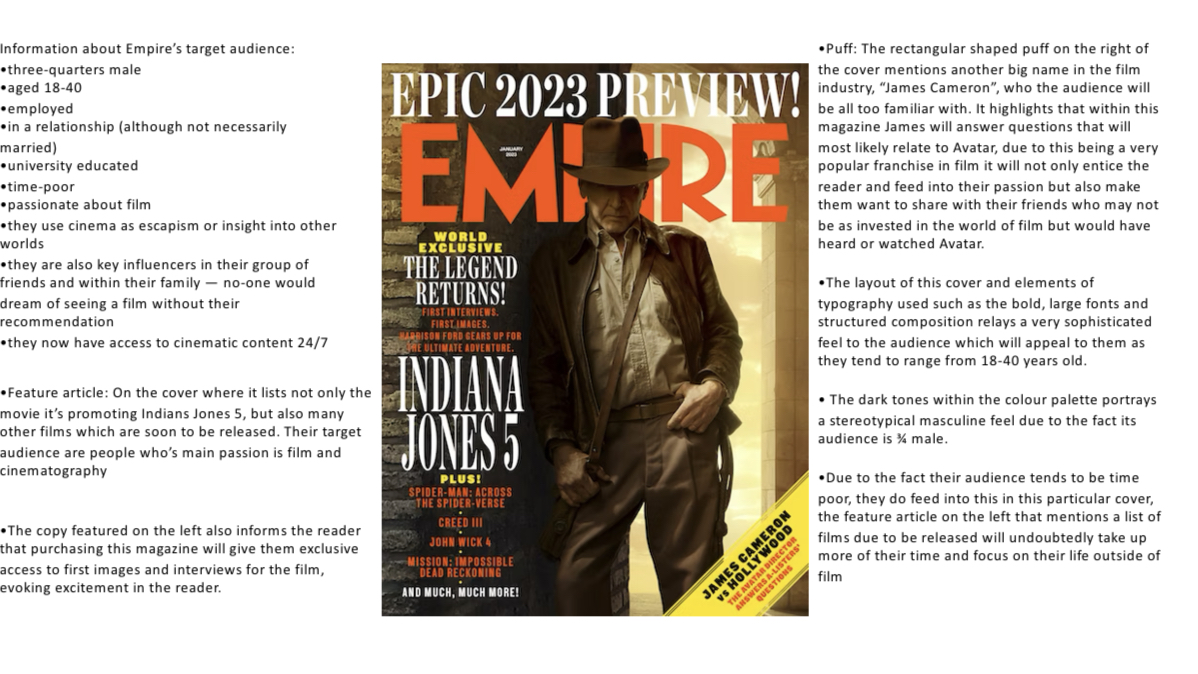
NEA Task 5 : How Does Empire Appeal To It's Target Audience?


NEA Task 4 : Research Into An Existing Bauer Film Magazine (Empire)

The film magazine 'Empire', produced by Bauer Media Group, is Britain's most popular film magazine with between 60,000 and 70,000 copies being bought a month. In their eyes, they are 'the worlds most influential film and entertainment brand'. Not only to they create print magazine, but they also have a podcast, website, digital edition and live events for their readers to enjoy. They work with and collaborate with the largest film studios, distributors, state of the art filmmakers and actors to create their content. They interview the biggest celebrities and have vast amounts of access to the media industry that they share with their readers. 

The Empire's readership is predominantly male, with them making up three quarters of their readers. Their target audience also ranges from 18 to 40 years old, are in employment, in a relationship, university educated and time-poor. Empires audience share a love and passion for film and use it as an escapism. These people have access to content from the film world 24/7 whether its a multiplex cinema or their laptop, Empire will always supply content to their readership.

The print magazine Empire produces some quite exclusive covers, for example they created the world's first voice-responsive taking cover for the film Deadpool 2, this magazine owns some of the largest first's in the film and entertainment industry. They have many connections within the film space, they receive exclusive on-set access to some of the biggest film sets, for example Marvel's Captain Marvel. Not only that but they also have the access to speak and interview the biggest Hollywood actors such as James Cameron, Lin-Manuel Miranda, Olivia Coleman and many other of the most talented actors in the industry. In their opinion they are the most 'knowledgeable and passionate' team in the industry due to their in depth knowledge and research they do into cinematography and the art of filmmaking.

Empires digital edition is an award- winning piece of media with its enhanced video content ,that is exclusive to other the digital edition, and their pages that include animations created by the design team to give that immersive feeling to the audience. Alongside this, their podcast is also attracting a fair amount of popularity with 51,000 downloads per week and is top 5 in the iTunes charts. On this podcast they answer reader questions and guests that appear weekly such as Nicole Kidman. They also host live events a few time in the year with the Empire Awards being the highlight of the year where many A-list guests attended such as Steven Spielberg, Mark Hamill, Hugh Jackman and many more.

My magazines target audience differs when comparing it to Empire's. This is due to the fact my target audience is ranged from 16-25 and Empire's is 18 to 40 which is a much larger demographic. People who are between the ages of 16-25 are usually still in some form of education meaning they will most likely not be in fulltime employment, however the readership of empire is mainly people who are employed.

NEA Task 3: Research into the UK Magazine Industry

 Research of the UK magazine Industry:

According to Press Gazelle, over the past few years the UK consumer industry has had a drastic shift, predominantly with many magazine companies moving to online and the obvious impact Covid-19 had on the industry. In terms of the kind of magazines that have been hurt the most in recent years, men's magazines have definitely been massively affected, specifically by competition from visual social media platforms like Instagram. However, if you compare this to magazines that cover topics such as current affairs or news that have not be hit nearly as bad. Despite this, print is still fairly popular but there has been a decline that has been falling for long while. This decline is partly due to the fact that subscriptions and digital editions of the magazines do not makeup for the sales that were lost in the drop. In the UK magazine industry it isn't rare to talk of the industry, however some of the more successful titles no longer see themselves in that way, or apart of the industry. This industry is dominated by publishers such as Bauer Media Group, Future PLC and Immediate Media company, these three companies put together are estimated to control 80% of the UK's print circulation. Magazines have been hit dramatic falls in print advertising revenue, as well as digital marketing have been taken over and now under the control of large tech companies such as Google and Facebook. For many years, advertising revenue has been declining in the UK Magazine scene, but it was the pandemic that caused the pace of the fall to be increased, it fell by 33% from 2019 to 2020 and has not recovered since. 

Magazine circulation has also massively decreased, in 2000 1.6 million magazines were circulated around the UK, however in 2021 this had decreased to 565 million according to Audit Bureau of Circulation. In the past 5 years, alongside men's magazines which circulation dropped by 89% from 32.3 million to 3.6 million between the years of 2017 to 2021, music magazine also decreased in popularity majorly, their circulation dropped by 90% to 1.8 million. Despite this, women's magazines are still quite popular when looking their circulation, in 2021 192 million magazines were circulated around the country, which is only a 45% decrease. According to Douglas McCabe, magazines that consumers are able to replace with something online are the ones which are affected the most. Online subscriptions seem like a good idea to increase revenue for companies, however they do not majorly benefit magazine industry, in 2021 subscriptions only accounted for 27% of magazines that were circulated in the UK and don't tend to be a priority for magazine publishers or readers. The magazine The Economist is an example of the small amount of magazines that will most likely remain a magazine due to its traditional content and that it is a valued magazine by the public. 

In 2022, magazines were seen to have accounted for £560.4 million of advertisement spending and magazine media is consumed by 76% of adults in the UK each month. However, consumer spending has decreased due to the fall in magazine popularity, in 2000 it was estimated that consumers spent £1.4 billion but in 2020 it was £669 million. This lead to the closing of a lot of magazines, in 2000 there was reportedly 700 titles across the UK, in 2010 it decreased to 558 and then a further decrease to 241 in 2010. 

Completed NEA

  Dear Moderator,  My name is Phoebe Birney. Welcome to my A Level Media Studies blog. This is a record of the work I have undertaken for th...